
幸福魔方(全文在线阅读)>
幸福魔方Years of war, rise in terrorism led to the current Israel-Hamas conflict, experts say_我的网站
A | 液冷板块今早开盘即迎来资金追捧。
B | The origin of the bloody conflict happening in Gaza and Israel is complicated given the long, disputed history of the region, according to experts who have spent decades studying the region.As the attacks continue in both countries, the experts fear that any attempts at truly achieving peace between the Palestinians and Israelis may have been pushed back heavily.Susannah Heschel, the chair of the Jewish Studies Program at Dartmouth University, who has written several books about this region, told ABC News that the conflicts run deep and as far back as the Middle Ages, but specifically, the most modern clashes have stemmed from the fallout of the 1967 Arab-Israeli war. On ABC News Live at 8:30 pm on Thursday, Oct. 12, ABC News' James Longman, Matt Gutman and Ian Pannell look at the horrendous toll from Hamas' massacre, the Israelis and Palestinians caught in the middle and what comes next.The war, known in Israel as the Six-Day War, ended with Israel gaining control of several territories, including the Gaza Strip, and that has led to the violence and political fallout that has befallen the area currently, Heschel, the school's Eli M. Black Distinguished Professor of Jewish Studies, said."What we are seeing today is the consequence of that war, or how the various parties to that war …responded to the end," she told ABC News.Following its battles with Egypt, Lebanon, Syria and Jordan, Israel touted its swift victory and new territory, which included lands with long historical significance to Israeli Jews, Heschel, who is teaching a course on the war this semester, said.At the same time, Israel had to deal with an influx of Arabs who now lived under its control, and the retaliation from the neighboring countries who still disputed Israel's claims over the land, she said."The question is, was that victory in fact in some way not a victory? Because the consequence of it was an enormous headache for Israel," Heschel said.Israel has been the target of several military excursions by the nations in that war, particularly Egypt, to try and regain some of that land including during the 1973 Arab-Israeli War, known in Israel as the Yom Kippur War. Egypt would eventually regain the Sinai Peninsula in 1982, following an agreement it signed with Israel three years prior.Gaza, however, remained under Israeli control and tensions continued to flare between Palestinians and Israelis who had begun constructing settlements in the region.The tensions came to a turning point in 1987 during the First Intifada, or "uprising," when Palestinians started to violently rebel against Israeli forces and civilians. It was during this time that Hamas emerged and began to stage violent strikes against Israeli forces.Chuck Freilich, a former deputy national security adviser in Israel and long-time senior fellow at Harvard's Kennedy School, told ABC News that Hamas' stance is simply to "wipe Israel off the map," and it has suppressed anyone within the Palestinian community who doesn't adhere to that."It's not a question of recognition," he said.By the time the Intifada ended in the early 90s, over 1,000 people had been killed, and Gaza was left in ruin from the fighting.Israel and the Palestine Liberation Organization would eventually agree to the Oslo Accords in 1993 which granted Palestinians the right to self-government.Heschel said the treaty was a good start but leaders on both sides could have done more to decrease the tensions and violence.Freilich said that the Palestinian Authority, which governed Gaza and continues to govern the West Bank, did try to crack down on terrorism alongside the Israeli government, but it was not always successful and groups like Hamas continued to incite and inflict violence on Israel.In 2000, a Second Intifada began, and hundreds more were hurt and killed in the violent protests. Five years later, the Israeli government voted to withdraw from Gaza and then-Israeli Prime Minister Ariel Sharon expelled 9,480 Jewish settlers from 21 settlements from the region."That withdrawal of the Jewish settlements left some Israeli Jews with the resentment that inflames them to this day," Heschel said.A 2006 election where Hamas became Gaza's leading party has led to increased violence, and a decline in economic resources for its people, as Israel and other nations cut off support. Israel and Egypt imposed a blockade on the coastal strip, which continues to this day."It's unfortunate that Hamas came into power. It's not supported by the majority of the people," Heschel said.Hamas, which contends it is resisting Israel’s oppression of Palestinians, continued to attack Israel in the subsequent years with rockets, kidnappings and other violence leading to major military action by Israel in 2008, 2012, and 2014."It's part of a long-term campaign to repeatedly weaken Israel with conflict after conflict," Freilich said.Freilich added that the recent turmoil within the Israeli government, from its multiple elections in the last six years to the recent turmoil over the changes to its judicial changes, have left Israeli leaders fractured."Their attention was diverted…and we saw the results on Saturday," he said.Last week's attack by Hamas that has killed over 900 Israeli citizens and wounded over 2,300 was unprecedented and puts the region in "uncharted territory," Heschel said.This is the first time in 50 years that civilians were attacked on Israeli soil and it will only lead to more devastation and destruction for both sides, according to the professor."What Hamas did was not to the benefit of the people of Gaza," Heschel said. "Everyone knows, anybody knows and Hamas certainly knew, that in attacking Israel and inflicting so much destruction and murder on Israeli civilians that there would be retaliation."Heschel and Freilich said that it is impossible to determine the long-term ramifications of Hamas' attack and Israel's retaliation, but said that both sides will be living in fear as the violence escalates."To even think that Israel would think at this point that Israel would include a peace process with [Hamas] is totally unrealistic," Freilich said.Even though emotions are high and there is still violence likely to continue for the foreseeable future, Heschel, insisted that Israeli and Palestinian leaders needed to push back against Hamas and its influence and really take time to work out the decades-festering issue over the land."Let's…try to think in clear terms about what we can do for the future so that things can get better," she said. "What's the strategy? Not the strategy for the moment but the strategy for 10, 20, 30 years from now. How can we get there?"。截至午间收盘,板块整体涨幅达0.79%,康盛股份、英维克双双涨停,申菱环境、同飞股份、朗特智能、豪尔赛全线跟涨。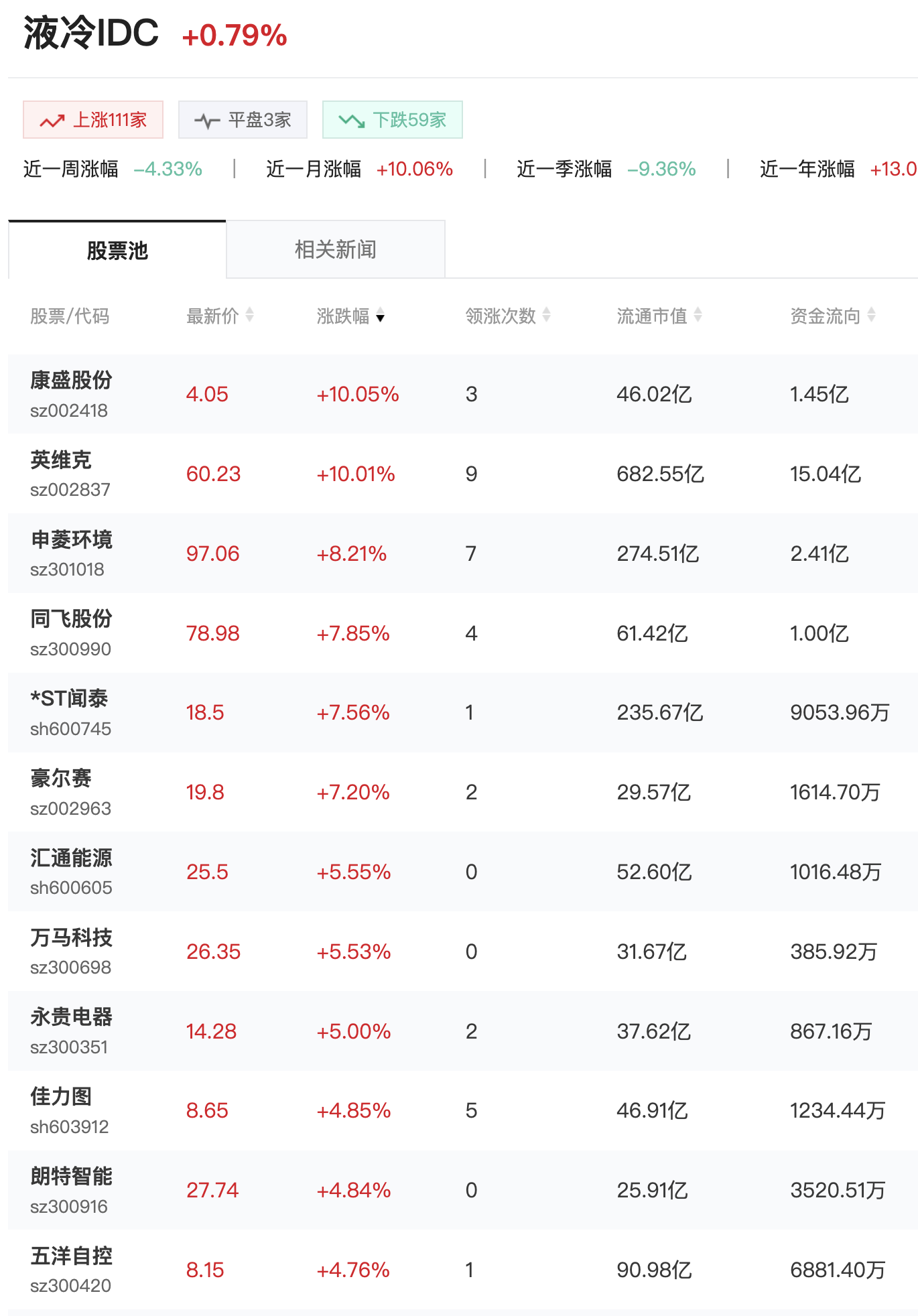 催化来自昨晚的一份半年报——8月24日晚间,液冷龙头英维克披露了2026年半年报,上半年营收30.17亿元,同比增长17.24%;二季度归母净利润环比暴增1934%。 AI太热了,不是比喻,是字面意思。 当英伟达最新AI服务器的冷却液温度可以飙到45摄氏度,比你家热水器的水温还高时,你就知道,散热这件事已经成了算力竞赛的“第二战场”。而A股的上市公司们,正闻风而动,掀起一场围绕液冷赛道的并购卡位战。 一根管道里的万亿生意 液冷是啥? 简单说,就是用水或特殊冷却液代替空气,把芯片的热量“搬”出去。传统数据中心靠风扇吹,跟夏天用电风扇一个道理——凉快是凉快,但芯片功率一上去就吹不动了。液体带走热量的能力是同体积空气的25倍,噪音还低25到30分贝。 目前最主流的方案叫“冷板式液冷”——把一块带微小通道的金属板贴在CPU/GPU上,冷却液流过板子,把热量带走。听着简单,但里面涉及微通道精密加工、密封防漏、材料兼容性等一系列高壁垒技术。 催化来自昨晚的一份半年报——8月24日晚间,液冷龙头英维克披露了2026年半年报,上半年营收30.17亿元,同比增长17.24%;二季度归母净利润环比暴增1934%。 AI太热了,不是比喻,是字面意思。 当英伟达最新AI服务器的冷却液温度可以飙到45摄氏度,比你家热水器的水温还高时,你就知道,散热这件事已经成了算力竞赛的“第二战场”。而A股的上市公司们,正闻风而动,掀起一场围绕液冷赛道的并购卡位战。 一根管道里的万亿生意 液冷是啥? 简单说,就是用水或特殊冷却液代替空气,把芯片的热量“搬”出去。传统数据中心靠风扇吹,跟夏天用电风扇一个道理——凉快是凉快,但芯片功率一上去就吹不动了。液体带走热量的能力是同体积空气的25倍,噪音还低25到30分贝。 目前最主流的方案叫“冷板式液冷”——把一块带微小通道的金属板贴在CPU/GPU上,冷却液流过板子,把热量带走。听着简单,但里面涉及微通道精密加工、密封防漏、材料兼容性等一系列高壁垒技术。
C | 这生意有多大?中金公司研报测算,全球散热器件市场2025至2027年的复合年增长率达59.8%。申万宏源更激进,预计2026年液冷市场空间超千亿,2028年突破3000亿元。而TrendForce的数据显示,液冷在AI芯片中的渗透率将从2025年的33%跃升至2026年的53%,明年逼近60%。
D | 一句话:风口来了。 上市公司液冷卡位战 最新的案例是远东股份。
E | 8月24日晚间,这家老牌线缆企业公告,子公司拟以2.16亿元收购富的旺旺80%股权,切入液冷散热核心部件领域。 远东股份的逻辑很清晰:公司已有算力芯片检测设备和全光互联业务,收购液冷资产,正好凑齐“供电—互联—散热”的AI基础设施闭环。这也是这一轮液冷并购潮的典型特征——产业补链型,在AI硬件产业链上找缺口,强化自身闭环能力。
F | 这不是孤例。
G | 今年以来,20多家上市公司公告涉足液冷领域,从做瓶盖的金富科技到做模具的祥鑫科技,跨度之大,堪称“跨界奇观”。东吴证券研报指出,液冷正从“可选”走向“必选”,英伟达Rubin平台已全面导入无风扇全液冷架构,这一趋势不可逆。
H | 液冷蓝海确实广阔,但“跨界”的船票,未必都能驶向黄金彼岸。答案,终究要落到那些冷板、分水器和CDU的出货量里。(文章来源:财联社)。 Current article:http://or6sfdj.bianneixuanbingqinyouxie.buzz/s1l6/rkoj.html Published on:06:33:35 |


 警惕并购“双刃剑” 当然,跨界并购历来是双刃剑。远东股份这次收购的静态市盈率约19倍,增值率达303%,并将产生新的商誉。若标的公司未来业绩不达预期,商誉减值就是埋下的雷。 东吴证券在研报中也给出谨慎判断:英伟达链目前仍由Cooler Master、AVC等台系厂商把持高端份额,大陆企业多通过代工或二供切入,短期赚的是加工利润;而Google链和国内CSP链,国产厂商直供机会才更明确。